
How Performance Marketing Can Maximize Your ROI: A Starter Guide
From setting up conversion tracking to optimizing ad spend, learn the fundamentals that drive measurable results.
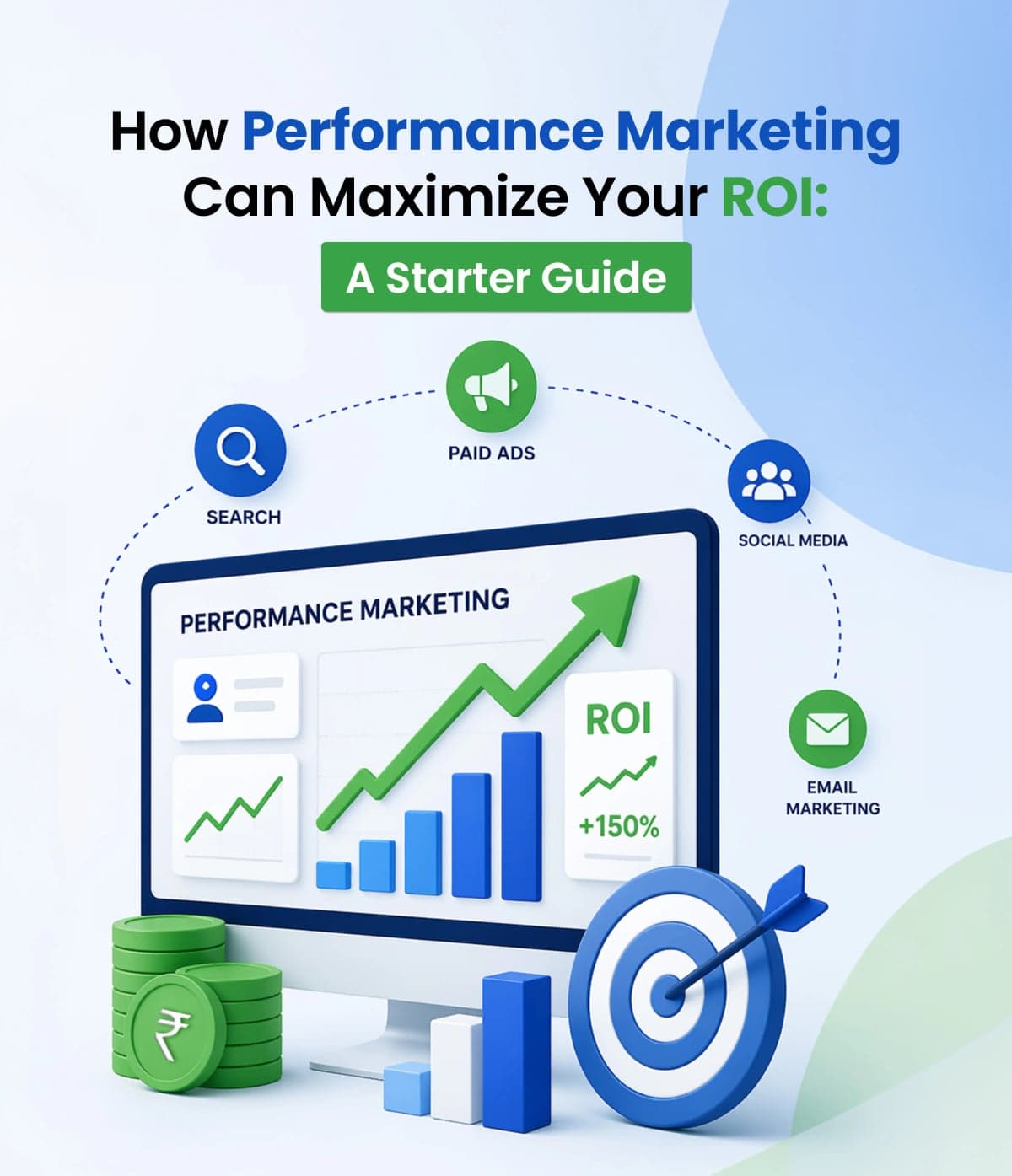
Well to be honest we all know that the era of spraying and praying with your advertising budget is officially dead. There was a time when putting up a billboard or running a generic radio spot felt like enough. You'd cross your fingers, hope for the best, and try to justify the expense through brand awareness. But in today's cutthroat digital landscape, awareness doesn't pay the bills conversions do. If you aren't tracking every single rupee or dollar that leaves your account, you aren't just marketing; you're gambling.
This is where the landscape shifts from vague promises to cold, hard data. Performance marketing has emerged not just as a trend but as the fundamental backbone for any business that actually cares about its bottom line. It's a ruthless, results-oriented discipline where you only pay when a specific action, a click, a lead, or a sale actually happens. It moves the needle from I think this is working to I know exactly how much profit this click generated.
If you're tired of burning cash on campaigns that vanish into the digital void, this performance marketing guide is your roadmap to fiscal sanity. Here is how you can pivot toward a ROI-driven marketing engine that fuels sustainable growth.
1. Master the Art of Precision Targeting
The biggest drain on your budget is showing ads to people who couldn't care less about your product. Performance-based strategies allow you to drill down into hyper-specific demographics, behaviors, and intent. By narrowing your focus, you drastically lower your cost per acquisition (CPA). You aren't shouting into a crowd; you're whispering directly to the person already looking for your solution.
2. Radical Transparency Through Real-Time Metrics
Unlike traditional media, where you wait weeks for a post-campaign report, digital marketing performance metrics give you a live scoreboard. You can see exactly which creative is resonating and which one is flatlining. This visibility allows you to kill underperforming ads instantly and double down on the winners before the day is even over.
3. Optimization of the Conversion Funnel
Getting traffic to your site is only half the battle. Conversion rate optimization (CRO) is the secret sauce that ensures that traffic doesn't go to waste. By testing different landing page layouts, button colors, and headlines, you streamline the user journey. Small tweaks here often lead to massive jumps in your final revenue without spending an extra dime on traffic.
4. Dominating the Auction with a Smart Google Ads Strategy
Search intent is the highest form of lead quality. A sophisticated Google Ads strategy ensures your brand appears at the exact moment a potential customer is searching for an answer. By bidding on high-intent keywords and maintaining a high quality score, you ensure your return on ad spend (ROAS) remains in the green.
5. The Power of Pay-Per-Outcome Models
The beauty of this approach is the accountability. In many performance channels, your interests are perfectly aligned with the platform or the affiliate. You pay for results, not "impressions." This shift in the financial model inherently protects your margins and forces every campaign to justify its existence on your balance sheet.
6. Continuous A/B Testing for Incremental Gains
Complacency is the enemy of profit. A robust performance marketing strategy relies on a culture of constant experimentation. By running split tests on everything from your ad copy to your offer structure, you uncover hidden pockets of ROI that your competitors are likely overlooking.
7. Leveraging Remarketing to Close the Loop
Most people won't buy the first time they see you. Performance marketing excels at "following" those warm leads and gently nudging them back to your site. Remarketing keeps your brand top-of-mind for those who have already expressed interest, significantly boosting the likelihood of a final conversion at a fraction of the cost of acquiring a new lead.
8. Data-Backed Scaling
When you find a campaign that works, you don't have to guess how much more to spend. Because you have a clear picture of your performance marketing for beginners metrics, you can scale your budget with total confidence.
The Verdict
The industry has fallen into the trap of thinking automation is a "set it and forget it" solution, when in reality, AI-driven campaigns are only as effective as the human strategy guiding them. We've reached a point where the tools are incredibly sharp, but they lack a pulse. An algorithm can calculate the probability of a click with terrifying speed, but it cannot understand the nuance of human desire, the cultural zeitgeist, or the long-term vision of a brand. Relying solely on the machine isn't efficient; it's an abdication of leadership.
In this high-speed digital economy, the real winners aren't those with the biggest tech stacks, but those who know how to steer the ship. To truly thrive, you must treat data as your co-pilot, not your captain. This requires moving beyond the surface-level metrics and diving into the core mechanics of how modern visibility actually translates into sustainable growth.
Ready to stop guessing and start growing?
Don't let another month of vague marketing drain your resources. Let's build a high-velocity, data-backed engine that turns your ad spend into a predictable revenue stream.
FAQs
1. Is performance marketing a one-time setup?
Definitely not. It's a living process that requires constant conversion rate optimization and creative refreshes to prevent your results from stagnating.
2. Which platform offers the best ROI?
It depends on your goal. A google ads strategy wins for high-intent searches, while social platforms often excel at lower-cost lead generation and brand discovery.
3. What is a "good" return on ad spend (ROAS)?
While it varies by industry, a common benchmark for ROI-driven marketing is a 4:1 ratio—meaning you earn four dollars for every one dollar spent.
4. How does automation affect my control over the budget?
Automation handles the heavy lifting of bidding, but you remain the pilot. You set the guardrails for your cost per acquisition so the machine never overspends.
5. Can performance marketing work for B2B brands?
Yes. By focusing on high-quality lead magnets and precise LinkedIn or search targeting, you can build a performance marketing strategy that fills your sales pipeline with qualified prospects.